Home / Fishes / Catfish / Butter catfish
No federal permit to keepButter catfish
Ompok bimaculatus
Fishes › Catfish (Siluriformes) › Siluridae (Glass and sheat catfish)
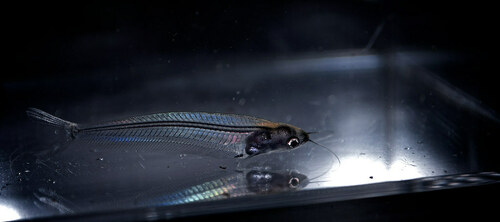
Ompok bimaculatus, known as butter catfish, is a species from the sheatfish family native to Asian countries such as Bangladesh, India, Pakistan, and Sri Lanka, but recently identified in Myanmar.

Care at a glance
Species-specific aquarium care
- Tank: At least 72 in long and 36 in front to back for one adult (adults commonly reach about 17.7 in / 45 cm).
- Water: Freshwater (tolerates brackish).
- Temperature: 68–79°F (range recorded for this species).
- pH: 6–8.
- Hardness: 4–28 dGH.
- Layout: Lives on or near the bottom: floor space and hiding places matter more than height.
Calculated from this species' own FishBase record: tank size from its typical adult length and swimming zone, water values from its recorded ranges. The group guide below fills in general care.
Care guide
Species care notes
- Tank: a base of at least 71 × 24 in (roughly 171 US gallons); space needed is rated “very large tank”.
- Water: a fairly wide range, from slightly acidic to slightly alkaline, 68–79 °F, pH 6–8, 4–28 dGH.
- Behaviour: temperament peaceful.
- Difficulty: Moderate (Seriously Fish rating).
Short excerpts from the species profile:
- Setup: “This species requires a lot of open swimming space, along with some suitably-sized hiding places.”
- Diet: “Relatively unfussy and will take most live, frozen and dried foods.”
- Tankmates: “Fairly peaceful and shy for its size, although it will eat any smaller fish it can fit in its mouth.”
- Breeding: “Thus far only achieved through the use of hormone injections in captivity.”
From the Seriously Fish profile for this species, which has the full habitat, maintenance, diet, behaviour and breeding write-up 167
Glass and sheat catfish
Applies to most species in this group. Habitat: The listed Asian silurids inhabit rivers, canals and seasonal floodwaters, while Kryptopterus macrocephalus specializes in peat-swamp forest and associated blackwater streams. Individual species can differ, so compare with the species numbers above and the linked sources.
Housing & setup
- For Kryptopterus bicirrhis, provide at least a 120 × 45 cm (about 48 × 18 inch) tank footprint, subdued light and cover.
- For K. macrocephalus, provide at least a 120 × 30 cm (about 48 × 12 inch) footprint, floating vegetation and a well-decorated dim environment.
- For Ompok bimaculatus, provide at least 180 × 60 × 60 cm (about 72 × 24 × 24 inches), open swimming room and suitably sized pipe shelters.
- Use mature filtration and regular water changes; Ompok needs powerful filtration to handle its waste and benefits from some current.
- Match chemistry to identity: K. macrocephalus is maintained at pH 4.0–7.0 and 1–8 dGH; Ompok has a much broader reported pH 6.0–8.0 and 4–28 dGH tolerance.
Climate & lighting
| Water | 68–78.8°F |
Diet
- Sinking prepared carnivore foods for established Kryptopterus.
- Bloodworm and other appropriately sized frozen invertebrates.
- Small earthworms for Kryptopterus; larger worms for Ompok.
- Prawn and mussel pieces for larger Ompok.
Social life
- Keep K. bicirrhis and K. macrocephalus in conspecific groups of at least four. Avoid boisterous competitors and fish small enough to swallow; Ompok is a much larger predator despite its relatively shy disposition.
Health watch
- Ammonia injury from failed filtration.
- Bacterial skin or fin infections associated with poor water quality.
Understanding the animal
About this animal
About this animal
It has also been identified in the Mekong Basin of Vietnam. Known in Thailand as pla cha-on (ปลาชะโอน), it is one of the very similar catfish species known in the markets as pla nuea on (วงศ์ปลาเนื้ออ่อน).
Quoted from the Wikipedia article “Ompok bimaculatus” (CC BY-SA 4.0) 174
In the wild
In the wild
From this species’ own FishBase record (habitat, bottom type, water and breeding data), not its family. Good care copies these conditions.1
| Where it lives | Lives in freshwater and brackish water, in rivers and streams. Stays near the bottom. Adults are found in quiet, shallow (0.5-1.5 m), often muddy water, in sandy streams, rivers and tanks. |
| Water it lives in | Freshwater / brackish water, 68–79 °F (20–26 °C), pH 6–8, hardness 4–28 dH, depth 0–2 m. |
| Climate | Tropical climate. |
What this means for care
- Keep water within its wild range, 68–79 °F.
- It tolerates or needs brackish water; check salinity needs before setup.
Native climate (measured)
Native climate (measured)
| Warm-season highs | about 96°F (up to 108°F in the hottest sampled areas) |
| Cool-season lows | about 58°F (down to 48°F in the coldest sampled areas) |
| Average temperature | 75–82°F across sampled records |
| Relative humidity | 59–75% on average (driest month about 58%) |
| Rainfall | about 1335 mm a year, with strong wet and dry seasons |
Measured at 217 wild occurrence records sampled against WorldClim 2.1 climate data (1970–2000 averages). Air conditions in the range are ecological context, not enclosure settings: microhabitats such as burrows, leaf litter or basking rocks can be cooler, warmer or more humid.
From the sources
From the sources
Quoted from the matching sections of reputable sources for this exact species. Specialist databases are used first; Wikipedia (community-edited, CC BY-SA 4.0) only fills gaps. Other sources are short credited quotes.
| Overview | Ompok bimaculatus, known as butter catfish, is a species from the sheatfish family native to Asian countries such as Bangladesh, India, Pakistan, and Sri Lanka, but recently identified in Myanmar. It has also been identified in the Mekong Basin of Vietnam. Known in Thailand as pla cha-on (ปลาชะโอน), it is one of the very similar catfish species known in the markets as pla nuea on (วงศ์ปลาเนื้ออ่อน). It is valued for its delicate flesh and is also used for making high-quality fish balls. — Wikipedia (community-edited) |
| Where it lives | Home ranges Population dynamics Growth parameters Max. ages / sizes Length-weight rel. Length-frequencies Mass conversion Recruitment Abundance Life cycle Reproduction Maturity Maturity/Gills rel. — FishBase |
| Appearance and size | Maximum length 45.0 cm sl male/unsexed. — FishBase |
| Biology | Adults are found in quiet, shallow (0.5-1.5 m), often muddy water, in sandy streams, rivers and tanks. Also occur in canals, beels and inundated fields. Feed on vegetable matter and fish. — FishBase |
Data and studies
The numbers
The numbers
Each bar is what one source reports. Where several sources weigh in, the dashed gold band marks their average.
Adult length
Maximum recorded length. Measured as standard length (snout to the base of the tail, not counting the tail fin). Fish in home aquariums often stay smaller than wild records.
Water temperature
Range the species tolerates in nature; aim for the middle.
Minimum tank footprint
Seriously Fish recommends a tank base of at least 71 × 24 in (about 171 US gallons).
Veterinary & husbandry research
Veterinary & husbandry research
- Influence of light intensity and photoperiod on embryonic development, survival and growth of threatened catfish Ompok bimaculatus early larvae Arambam K et al., Journal of fish biology 2020
- Ontogeny of the digestive tract in butter catfish Ompok bimaculatus (Bloch) larvae Pradhan PK et al., Fish physiology and biochemistry 2012
- Development of novel microsatellite markers for population differentiation and detection of natural selection in wild populations of butter catfish, Ompok bimaculatus (Bloch, 1794) Chowdhury LM et al., Molecular biology reports 2023
Peer-reviewed papers that mention this species alongside captivity, zoos, veterinary care or aquaculture. Some cover several species or mention it only in passing, so check the abstract. 170
Sources for this sheet
- FishBase (Froese & Pauly, eds.), version 24.07 Peer-reviewed researchThe global scientific database on fishes, maintained by a consortium of research institutions; every value is referenced.
- Seriously Fish species profiles Experienced keeper or breederLong-running aquarium reference written and peer-checked by experienced fishkeepers and ichthyologists; each profile covers habitat, tank size, water, diet, behaviour and breeding.
- Seriously Fish: Kryptopterus bicirrhis Experienced keeper or breederAdded in the 2026 source-checked care-guide review.
- Seriously Fish: Kryptopterus macrocephalus Experienced keeper or breederAdded in the 2026 source-checked care-guide review.
- Seriously Fish: Ompok bimaculatus Experienced keeper or breederAdded in the 2026 source-checked care-guide review.
- FishBase: Kryptopterus geminus Peer-reviewed researchAdded in the 2026 source-checked care-guide review.
- Merck Veterinary Manual: Disorders and Diseases of Fish Zoo, university or veterinaryAdded in the 2026 source-checked care-guide review.
- Wikipedia (species article) Community referenceFree encyclopedia; useful overviews with their own citations. Intro text is quoted under CC BY-SA 4.0.
- PubMed (U.S. National Library of Medicine) Peer-reviewed researchIndex of peer-reviewed veterinary, zoo and husbandry research.