Home / Fishes / Arowanas and elephantfish / Bronze featherback
No federal permit to keepBronze featherback
Notopterus notopterus
Fishes › Arowanas and elephantfish (Osteoglossiformes) › Notopteridae (Asian and African knifefish)
The bronze featherback (Notopterus notopterus) is a ray-finned fish in the family Notopteridae found in South and Southeast Asia.
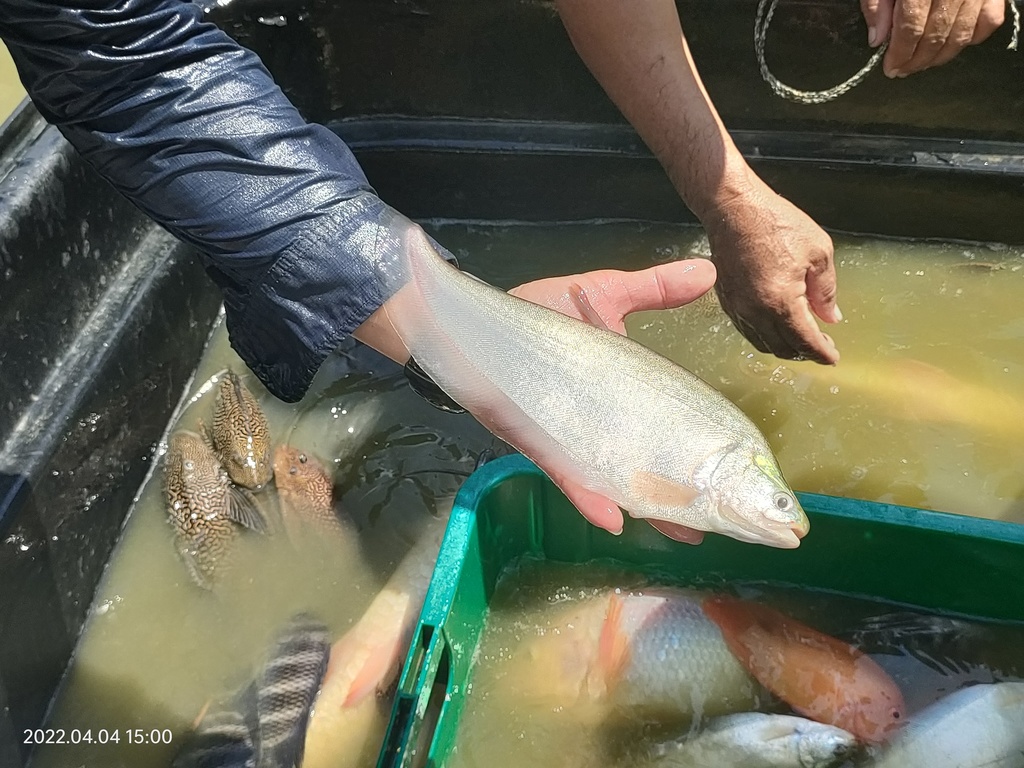
Care at a glance
Species-specific aquarium care
- Tank: At least 42 in long and 21 in front to back for one adult (adults commonly reach about 9.8 in / 25 cm; the largest recorded was 23.6 in).
- Water: Freshwater (tolerates brackish).
- Temperature: 75–82°F (range recorded for this species).
- pH: 6–6.5.
- Hardness: 3–8 dGH.
- Layout: Lives on or near the bottom: floor space and hiding places matter more than height.
- Diet: A predator: feed meaty foods sized to its mouth (frozen fish, shrimp, worms); it will eat tankmates that fit in its mouth. FishBase classes it as a carnivore.
Calculated from this species' own FishBase record: tank size from its typical adult length and swimming zone, water values from its recorded ranges. The group guide below fills in general care.
Care guide
Species care notes
- Water: a fairly wide range, from slightly acidic to slightly alkaline, 68–82 °F, pH 6–8, 2–15 dGH.
- Behaviour: temperament peaceful; kept alone; not a community fish.
- Difficulty: Moderate (Seriously Fish rating).
Short excerpts from the species profile:
- Setup: “Prefers dim lighting and access to refuges in the form of driftwood, large rocks or lengths of plastic piping.”
- Diet: “An obligate, typically nocturnal, predator feeding on smaller fishes, crustaceans and other invertebrates in nature but in most cases adapting well to dead alternatives in captivity.”
- Tankmates: “Relatively peaceful with fishes too large to be considered prey but can be territorial with conspecifics and other similarly-shaped species, especially if space is at a premium.”
From the Seriously Fish profile for this species, which has the full habitat, maintenance, diet, behaviour and breeding write-up 167
Asian and African knifefishes
Applies to most species in this group. Habitat: Notopterids inhabit African and Asian freshwaters, including still, vegetated waters, rivers, lakes and floodplains, with Chitala ornata entering flooded forest to spawn. Individual species can differ, so compare with the species numbers above and the linked sources.
Housing & setup
- For Xenomystus nigri, the cited lifetime aquarium is approximately 120 x 45 x 38 cm, about 205 litres, for one fish.
- For Chitala ornata, plan a public installation or exceptionally large specialist aquarium: adults reach about 100 cm standard length.
- Provide dim light and refuges made from smooth wood, rocks or appropriately sized pipes; planted cover and soft sand particularly suit X. nigri.
- For large Chitala, install mature filtration, oxygenated water and substantial regular water changes; the C. ornata reference specifies 50–70% weekly.
- Preserve access to the water surface for atmospheric breathing.
Diet
- Bloodworms and earthworms, with smaller portions for juveniles.
- Prawns or shrimp and chopped mussels.
- Marine fish flesh for larger Chitala.
- Carnivore pellets if accepted, with varied meaty foods rather than pellets alone for C. ornata.
Social life
- Keep fish too large to swallow as any companions; provide separation for territorial adults. X. nigri becomes less tolerant of its own species with maturity, and Notopterus notopterus is more aggressive.
Health watch
- Nutritional organ damage from unsuitable mammalian or avian meat in Chitala.
- Ammonia toxicity under inadequate filtration.
- White spot disease, a general freshwater aquarium risk.
Understanding the animal
About this animal
About this animal
Although primarily found in fresh water, it has been known to enter brackish water. At present, it is the only member of the genus Notopterus, but as currently defined, it is likely a species complex.
Quoted from the Wikipedia article “Bronze featherback” (CC BY-SA 4.0) 174
In the wild
In the wild
From this species’ own FishBase record (habitat, bottom type, water and breeding data), not its family. Good care copies these conditions.1
| Where it lives | Lives in freshwater and brackish water, in rivers and streams, lakes, rice paddies. Stays near the bottom. Found in clear streams and enters brackish waters. |
| Water it lives in | Freshwater / brackish water, 75–82 °F (24–28 °C), pH 6–6.5, hardness 3–8 dH. |
| Climate | Tropical climate. |
| Wild diet | Hunting macrofauna (predator). |
| Behavior to plan for | Breeding: clutch tenders, paternal parental care. |
What this means for care
- Keep water within its wild range, 75–82 °F.
- It tolerates or needs brackish water; check salinity needs before setup.
- Parents guard eggs or young, so expect territorial behavior when breeding.
Native climate (measured)
Native climate (measured)
| Warm-season highs | about 94°F (up to 102°F in the hottest sampled areas) |
| Cool-season lows | about 62°F (down to 51°F in the coldest sampled areas) |
| Average temperature | 75–82°F across sampled records |
| Relative humidity | 71–77% on average (driest month about 62%) |
| Rainfall | about 1595 mm a year, with strong wet and dry seasons |
Measured at 239 wild occurrence records sampled against WorldClim 2.1 climate data (1970–2000 averages). Air conditions in the range are ecological context, not enclosure settings: microhabitats such as burrows, leaf litter or basking rocks can be cooler, warmer or more humid.
From the sources
From the sources
Quoted from the matching sections of reputable sources for this exact species. Specialist databases are used first; Wikipedia (community-edited, CC BY-SA 4.0) only fills gaps. Other sources are short credited quotes.
| Overview | The bronze featherback (Notopterus notopterus) is a ray-finned fish in the family Notopteridae found in South and Southeast Asia. Although primarily found in fresh water, it has been known to enter brackish water. At present, it is the only member of the genus Notopterus, but as currently defined, it is likely a species complex. — Wikipedia (community-edited) |
| Where it lives | Home ranges Population dynamics Growth parameters Max. ages / sizes Length-weight rel. Length-frequencies Mass conversion Recruitment Abundance Life cycle Reproduction Maturity Maturity/Gills rel. — FishBase |
| Reproduction | Spawning occurs at night. — FishBase |
| Appearance and size | Maximum length 60.0 cm sl male/unsexed. — FishBase |
| Biology | Obligate air-breathing; Found in clear streams and enters brackish waters. Adults inhabit standing and sluggish waters of lakes, floodplains, canals and ponds. Undertake localized lateral migrations from the Mekong River to floodplains during the flood season and back to the mainstream or other permanent water bodies during the dry season. — FishBase |
Data and studies
The numbers
The numbers
Each bar is what one source reports. Where several sources weigh in, the dashed gold band marks their average.
Adult length
Common length to maximum recorded length. Measured as standard length (snout to the base of the tail, not counting the tail fin). Fish in home aquariums often stay smaller than wild records.
Water temperature
Range the species tolerates in nature; aim for the middle.
Veterinary & husbandry research
Veterinary & husbandry research
- Seasonal variations in diet composition, diet breadth and dietary overlap between three commercially important fish species within a flood-pulse system: The Tonle Sap Lake (Cambodia) Heng K et al., PloS one 2018
Peer-reviewed papers that mention this species alongside captivity, zoos, veterinary care or aquaculture. Some cover several species or mention it only in passing, so check the abstract. 170
Sources for this sheet
- FishBase (Froese & Pauly, eds.), version 24.07 Peer-reviewed researchThe global scientific database on fishes, maintained by a consortium of research institutions; every value is referenced.
- Seriously Fish species profiles Experienced keeper or breederLong-running aquarium reference written and peer-checked by experienced fishkeepers and ichthyologists; each profile covers habitat, tank size, water, diet, behaviour and breeding.
- Seriously Fish: Xenomystus nigri Experienced keeper or breederAdded in the 2026 source-checked care-guide review.
- Seriously Fish: Chitala ornata Experienced keeper or breederAdded in the 2026 source-checked care-guide review.
- Merck Veterinary Manual: Disorders and Diseases of Fish Zoo, university or veterinaryAdded in the 2026 source-checked care-guide review.
- Wikipedia (species article) Community referenceFree encyclopedia; useful overviews with their own citations. Intro text is quoted under CC BY-SA 4.0.
- PubMed (U.S. National Library of Medicine) Peer-reviewed researchIndex of peer-reviewed veterinary, zoo and husbandry research.
- iNaturalist (captive observations) Community referenceCommunity observation platform run by the California Academy of Sciences and National Geographic; observations marked captive show animals living in homes, zoos and aquariums.
More asian and african knifefish

African brown knifefish
Xenomystus nigri
Aquarium hobby

Clown featherback
Chitala ornata
Aquarium hobby

Clown knifefish
Chitala chitala
Aquarium hobby
Reticulate knifefish
Papyrocranus afer
Aquarium hobby

Royal knifefish
Chitala blanci
Aquarium hobby