Home / Fishes / Cichlids / Cichlidae / Blue discus
No federal permit to keepBlue discus
Symphysodon aequifasciatus
Fishes › Cichlids (Cichliformes) › Cichlidae (Cichlids)
Symphysodon aequifasciatus, the blue discus or brown discus, is a species of cichlid native to rivers of the eastern and central Amazon Basin downriver from the Purus Arch.

Care at a glance
Species-specific values
Values researched for this exact species. Where they differ from the group guide below, follow these. Air, surface and water temperatures are listed separately, and each source is kept as published rather than averaged.
| Tank dimensions recommendation | length: 120 cm; width: 45 cm; height: 45 cm Few juveniles OR one breeding pair of adults; not an adult group minimum. | 285 |
| Wild standard length | 140 mm SL Wild size statement; not a captive strain maximum. | 285 |
Species-specific aquarium care
- Tank: At least 24 in long and 12 in front to back for one adult (adults commonly reach about 5.4 in / 13.7 cm).
- Water: Freshwater.
- Temperature: 79–86°F (range recorded for this species).
- pH: 5–8.
- Hardness: 0–12 dGH.
- Layout: Uses both the bottom and open water: give open swimming space plus cover near the substrate.
- Diet: Eats a varied diet: mix quality prepared foods with frozen and live foods. FishBase classes it as a carnivore.
Calculated from this species' own FishBase record: tank size from its typical adult length and swimming zone, water values from its recorded ranges. The group guide below fills in general care.
Care guide
Species care notes
- Behaviour: a shoaling fish best kept in a group of six or more; suited to a community tank.
- Difficulty: Moderate (Seriously Fish rating).
Short excerpts from the species profile:
- Setup: “Many Discus fanatics choose to go down the heavily planted route which can be particularly beneficial to Symphysodon aequifasciatus due to the amount of cover afforded by such a setup.”
- Diet: “Wild fish feed mainly on zoplankton, insects and other small invertebrates.”
From the Seriously Fish profile for this species, which has the full habitat, maintenance, diet, behaviour and breeding write-up 167
Discus
Applies to most species in this group. Habitat: Floodplain lakes of the Amazon. Individual species can differ, so compare with the species numbers above and the linked sources.
Housing & setup
- Large, tall tanks (55 gallons+ for a group), soft acidic water (pH 5.5–7) and very warm temperatures (82–88 °F).
- Frequent, large water changes; many keepers change 30–50% several times a week.
Climate & lighting
| Water | 82–88°F |
Diet
- High-quality discus pellets, frozen bloodworms and beefheart mixes, several small feedings daily for juveniles.
Social life
- Groups of five or more; shy and peaceful.
Health watch
- Hexamita (hole-in-the-head) and stress diseases in poor water; buy from reputable breeders.
Understanding the animal
About this animal
About this animal
This discus is found in black-, clear- and whitewater, but its preference for lentic habitats such as floodplains and flooded forests means that the whitewater it inhabits contain little suspended material (unlike main sections of whitewater rivers). It is largely restricted to water with a high temperature of 25–32 °C (77–90 °F) and a pH of 5.2–7.7.
Quoted from the Wikipedia article “Symphysodon aequifasciatus” (CC BY-SA 4.0) 174
In the wild
In the wild
From this species’ own FishBase record (habitat, bottom type, water and breeding data), not its family. Good care copies these conditions.1
| Where it lives | Lives in freshwater. Uses both the bottom and open water. In deep, rocky areas in crevices and among roots. Normally in schools, but territorial during breeding season. Feeds on insect larvae, insects, and planktonic invertebrates. Aquarium keeping: in groups of 5 or more individuals; keep pairs in small tanks for breeding; minimum aquarium size 120 cm. |
| Water it lives in | Freshwater, 79–86 °F (26–30 °C), pH 5–8, hardness 12 dH. |
| Climate | Tropical climate. |
| Behavior to plan for | Breeding: clutch tenders. |
What this means for care
- Keep water within its wild range, 79–86 °F.
Native climate (measured)
Native climate (measured)
| Warm-season highs | about 90°F (up to 92°F in the hottest sampled areas) |
| Cool-season lows | about 71°F (down to 68°F in the coldest sampled areas) |
| Average temperature | 79–81°F across sampled records |
| Relative humidity | 83–85% on average (driest month about 80%) |
| Rainfall | about 2418 mm a year |
Measured at 32 wild occurrence records sampled against WorldClim 2.1 climate data (1970–2000 averages). Air conditions in the range are ecological context, not enclosure settings: microhabitats such as burrows, leaf litter or basking rocks can be cooler, warmer or more humid.
From the sources
From the sources
Quoted from the matching sections of reputable sources for this exact species. Specialist databases are used first; Wikipedia (community-edited, CC BY-SA 4.0) only fills gaps. Other sources are short credited quotes.
| Overview | Symphysodon aequifasciatus, the blue discus or brown discus, is a species of cichlid native to rivers of the eastern and central Amazon Basin downriver from the Purus Arch. This discus is found in black-, clear- and whitewater, but its preference for lentic habitats such as floodplains and flooded forests means that the whitewater it inhabits contain little suspended material (unlike main sections of whitewater rivers). It is largely restricted to water with a high temperature of 25–32 C and a pH of 5.2–7.7. — Wikipedia (community-edited) |
| Where it lives | Home ranges Population dynamics Growth parameters Max. ages / sizes Length-weight rel. Length-frequencies Mass conversion Recruitment Abundance Life cycle Reproduction Maturity Maturity/Gills rel. — FishBase |
| Biology | In deep, rocky areas in crevices and among roots. Normally in schools, but territorial during breeding season. Feeds on insect larvae, insects, and planktonic invertebrates. — FishBase |
| History and naming | The taxonomy is disputed, but FishBase follows a review of the genus from 2006. In 2007 it was suggested that the correct scientific name of the blue/brown discus is S. haraldi, whereas S. aequifasciatus is the correct name for the green discus. — Wikipedia (community-edited) |
Data and studies
The numbers
The numbers
Each bar is what one source reports. Where several sources weigh in, the dashed gold band marks their average.
Adult length
Maximum recorded length. Measured as standard length (snout to the base of the tail, not counting the tail fin). Fish in home aquariums often stay smaller than wild records.
Water temperature
Range the species tolerates in nature; aim for the middle.
pH
Water hardness
Veterinary & husbandry research
Veterinary & husbandry research
- Intriguing evidence of translocations in Discus fish (Symphysodon, Cichlidae) and a report of the largest meiotic chromosomal chain observed in vertebrates Gross MC et al., Heredity 2009
- Cryptobia iubilans infection in juvenile discus Yanong RP et al., Journal of the American Veterinary Medical Association 2004
- Isoenzyme electrophoretic patterns in discus fish (Symphysodon aequifasciatus Pellegrin, 1904 and Symphysodon discus Heckel, 1840) from the Central Amazon Silva CA et al., Genetics and molecular research: GMR 2008
- Effect of increasing lipid levels on liver metabolism, intestinal morphology and production performance of discus fish (Symphysodon aequifasciatus) Santos RFB et al., Brazilian journal of biology = Revista brasleira de biologia 2025
Peer-reviewed papers that mention this species alongside captivity, zoos, veterinary care or aquaculture. Some cover several species or mention it only in passing, so check the abstract. See all 5 on PubMed → 170
Sources for this sheet
- FishBase (Froese & Pauly, eds.), version 24.07 Peer-reviewed researchThe global scientific database on fishes, maintained by a consortium of research institutions; every value is referenced.
- Seriously Fish species profiles Experienced keeper or breederLong-running aquarium reference written and peer-checked by experienced fishkeepers and ichthyologists; each profile covers habitat, tank size, water, diet, behaviour and breeding.
- Merck Veterinary Manual: Management of aquarium fish Zoo, university or veterinaryThe Merck Veterinary Manual: a standard veterinary reference written and reviewed by veterinary specialists.
- Merck Veterinary Manual: Types and features of aquatic systems Zoo, university or veterinaryThe Merck Veterinary Manual: a standard veterinary reference written and reviewed by veterinary specialists.
- Wikipedia (species article) Community referenceFree encyclopedia; useful overviews with their own citations. Intro text is quoted under CC BY-SA 4.0.
- PubMed (U.S. National Library of Medicine) Peer-reviewed researchIndex of peer-reviewed veterinary, zoo and husbandry research.
- iNaturalist (captive observations) Community referenceCommunity observation platform run by the California Academy of Sciences and National Geographic; observations marked captive show animals living in homes, zoos and aquariums.
More cichlids

Agassiz's dwarf cichlid
Apistogramma agassizii
Aquarium hobby

Altolamprologus calvus
Altolamprologus calvus
Aquarium hobby

Altum Angel
Pterophyllum altum
Aquarium hobby
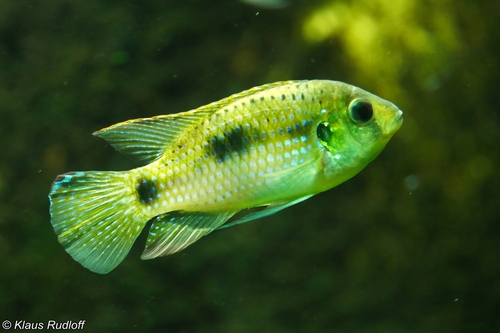
Anomalochromis thomasi
Anomalochromis thomasi
Aquarium hobby

Apistogramma eremnopyge
Apistogramma eremnopyge
Aquarium hobby
Argentine humphead
Gymnogeophagus balzanii
Aquarium hobby