Home / Reptiles / Lizards / Bearded dragon
No federal permit to keep In-depth sheetBearded dragon
Pogona vitticeps
Reptiles › Lizards (Lacertilia) › Agamidae (Agamas and dragons)
Bearded dragons are calm, curious Australian lizards that need serious heat and strong UVB. Clint's Reptiles scores them 3.8/5.
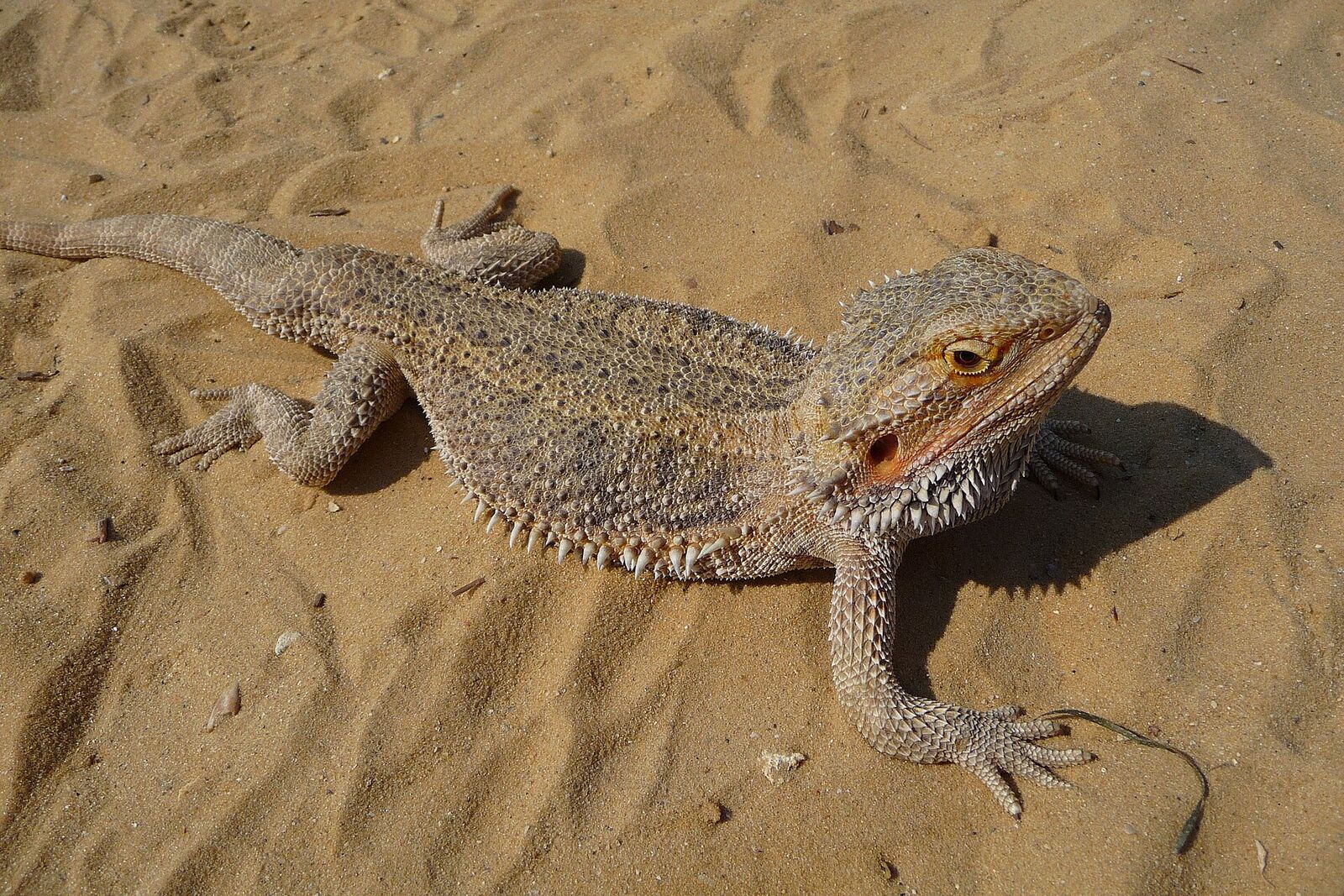
Care at a glance
Species-specific values
Values researched for this exact species. Where they differ from the group guide below, follow these. Air, surface and water temperatures are listed separately, and each source is kept as published rather than averaged.
| Basking surface temperature | 108–113 °F ReptiFiles recommendation | 198 |
| Cool surface temperature | 77–85 °F ReptiFiles recommendation | 198 |
| Air temperature day gradient | 72–99 °F ReptiFiles recommendation | 198 |
| Air temperature night | 55–75 °F ReptiFiles recommendation | 198 |
| Humidity | 30–60 % RH ReptiFiles recommendation | 198 |
| Uv index basking | 4–4.5 UVI ReptiFiles recommendation | 198 |
| Enclosure minimum | length: 72 in; width: 24 in; height: 24 in Single typical adult; small-adult exception remains in source | 199 |
| Adult total length | 19–23 in Source-reported average total-length range, not maximum | 199 |
| Social | Individual housing recommended. | 199 |
| Preferred air temperature zone | 77–90 °F (25–32 °C) Veterinary POTZ; not water or basking surface. | 218 |
| Relative humidity | 20–30 % Veterinary table; corn snake, leopard gecko, bearded dragon and savannah monitor require more humidity during shedding. | 218 |
Care guide
Enclosure
- Minimum 48×24×24 in; cool end about 77°F; nights no lower than about 68°F.
- Strong UVB (10–12%) for about 12 hours a day.
Sources 29
Diet
- Juveniles eat mostly insects; adults eat salad daily and insects a couple of times a week, dusted with calcium.
Sources 61
Housing
- One dragon per enclosure.
Sources 61
Show the group care guide for bearded dragons
Bearded dragons
Applies to most species in this group. Habitat: Australian arid woodland. Individual species can differ, so compare with the species numbers above and the linked sources.
Housing & setup
- For Pogona vitticeps, ReptiFiles now recommends 6×2×2 ft; its 4×2×2 exception is for adults under approximately 18 inches.
- Strong T5 UVB across a third to half of the enclosure, with a hot basking spot.
Climate & lighting
Starting point only: Move central-bearded-dragon numbers to species overrides; distinguish basking surface, air gradient, cool surface and night air. Check the species-specific values for this animal where shown.
| Basking spot | 105–110°F |
| Warm side / daytime | 85–90°F |
| Cool side | 72–80°F |
| Humidity | 30–40% |
- UVB: Required (strong).
Diet
- Juveniles mostly insects; adults mostly greens and vegetables with some insects.
- Dust insects with calcium.
Social life
- House central bearded dragons individually; ReptiFiles advises against cohabitation.
Health watch
- MBD, obesity and gravid females retaining eggs; a lay box is needed for females.
Understanding the animal
In the wild
In the wild
Researched for this exact species, not its family. Good care copies these conditions.1234567
| Where it lives | Occurs across the semi-arid interior of eastern and central Australia, including western New South Wales and the Riverina. It occupies arid to semi-arid woodland, shrubland and hummock grassland, using the ground, elevated branches and burrow refuges. |
| Ground it lives on | Dry soil, including red sandy ground, among grasses and shrubs; also climbs branches and other elevated perches and uses burrows. |
| Climate | Arid to semi-arid conditions with strong daily and seasonal thermal variation. A wild female was observed basking at an air temperature of 59°F (15°C); a Queensland field study estimated mean body temperatures from about 69°F (20.8°C) in winter to 92°F (33.4°C) in summer, which are body measurements rather than ambient climate ranges. A quantitative wild humidity range was not established. |
| Active | Diurnal; during the hottest season activity concentrates in early morning and late afternoon. Winter cooling can produce brumation, although some winter basking occurs. |
| Social life | Individuals exhibit dominance and submission rather than stable flock-like groups; males use head bobbing and dark beard displays toward rivals and potential mates. |
| Wild diet | Omnivorous: leaves and fruit, ants, beetles and other invertebrates, and occasional small vertebrates such as lizards. |
| Behavior to plan for | Climbs to bask and shifts among sun, shade and refuges to regulate temperature. Inflating and darkening the beard, gaping, head bobbing and arm waving communicate defense, dominance or submission. |
What this means for care
- Provide sturdy elevated basking perches as well as ground space and covered refuges.
- Create accessible warm and cool areas so it can choose its thermal exposure.
- Offer both suitable plant foods and invertebrates rather than an exclusively insect-based diet.
- Use individual housing to prevent dominance displays from becoming persistent intimidation.
- Australian Museum: Central Bearded Dragon
- Animal Diversity Web: Pogona vitticeps
- Wild et al. (2025): Thermal performance curves, activity and survival in a free-ranging ectotherm
- Niche modeling for the genus Pogona in Australia (2018)
- Wikipedia: Central bearded dragon
- Bearded Dragon Care Guide
- Bearded Dragon Care Sheet
Native climate (measured)
Native climate (measured)
| Warm-season highs | about 94°F (up to 98°F in the hottest sampled areas) |
| Cool-season lows | about 41°F (down to 39°F in the coldest sampled areas) |
| Average temperature | 63–70°F across sampled records |
| Relative humidity | 36–51% on average (driest month about 30%) |
| Rainfall | about 297 mm a year, spread fairly evenly |
| Winters | Cool to cold winters (lows around 41°F) in much of its native range. Seasonal slowdown may be relevant, but species-specific biology determines whether brumation or hibernation occurs. |
Measured at 136 wild occurrence records sampled against WorldClim 2.1 climate data (1970–2000 averages). Air conditions in the range are ecological context, not enclosure settings: microhabitats such as burrows, leaf litter or basking rocks can be cooler, warmer or more humid.
Profile
Profile
Researched for this exact species. Sources are listed under In the wild above.
History
Pogona vitticeps was formally described by German zoologist Ernst Ahl in 1926, originally in the genus Amphibolurus. Extensive captive breeding has since produced numerous color and scale-texture morphs.
Keeper tips
- Provide sturdy climbing branches because bearded dragons naturally climb.
- Provide both basking opportunities and shaded retreats when housed outdoors.
- Account for natural digging and burrowing behavior.
- Outdoor housing during suitable warm weather should also provide shelter from rain.
- Captive-bred animals are recommended over wild-caught animals because they are generally healthier and better acclimated to captivity.
Behaviors reported
- Slowly waves a forelimb as a submission or species-recognition signal.
- Inflates and darkens the beard during aggression, courtship, or threat displays.
- Flattens and expands the body when threatened.
- Frequently basks on elevated objects.
- Females can store sperm and produce multiple fertile clutches from one mating.
Unique adaptations
- A sticky tongue helps capture insect prey.
- A parietal or 'third' eye on top of the head helps detect predators.
- Soft-looking spiky scales can be tightened into sharper defensive spines.
- The body can darken to absorb heat more efficiently.
- The abdomen can be inflated to aid floating in deep water.
Remarkable facts
- Adults commonly reach about 18-24 inches in total length.
- The species is native to eastern and central Australia.
- Males are generally larger than females.
- Sexual maturity is generally reached at one to two years.
- Females may lay up to 24 eggs in a clutch and can produce multiple clutches.
- Natural coloration varies with local soil and may include brown, tan, red, or gold tones.
Stories
- The species' famous 'arm wave' resembles a human waving hello, but the documented functions include submission and species recognition.
- Its common name comes from the expandable throat pouch, which can darken dramatically and resemble a beard during displays.
From the sources
From the sources
Quoted from the matching sections of reputable sources for this exact species. Specialist databases are used first; Wikipedia (community-edited, CC BY-SA 4.0) only fills gaps. Other sources are short credited quotes.
| Overview | The central bearded dragon (Pogona vitticeps), also known commonly as the inland bearded dragon, is a species of lizard in the family Agamidae. The species is native to eastern and central Australia. Its common name refers to the pouch under their chin that they can inflate and darken in coloration, similar to the frilled lizard. The bearded dragon grows to around up to 60 cm (24 in) from head to tail tip and can weigh 550 g (1.2 lb). — Wikipedia (community-edited) |
| Where it lives | Pogona vitticeps occupies a large range of habitats from the desert to dry forests and scrublands. — Animal Diversity Web |
| Wild diet | Pogona vitticeps are opportunistic omnivores. — Animal Diversity Web |
| Behavior | The beard of Pogona vitticeps is used for both mating and agression displays. — Animal Diversity Web |
| Reproduction | High incubation temperatures of eggs reverse genotypic males (ZZ) to phenotypic females in P. vitticeps, which has genetic sex determination (GSD) with female heterogamety. Between 22° and 32°C, sex ratios did not differ significantly from 1:1, a response consistent with GSD. — The Reptile Database |
| Appearance and size | Inland Bearded Dragons are 13 to 24 inches long, including the tail. — Animal Diversity Web |
| History and naming | Pogona vitticeps was first described by German zoologist Ernst Ahl in 1926, who placed it in the genus Amphibolurus. — Wikipedia (community-edited) |
Data and studies
Researched care notes
Researched care notes
Findings checked against veterinary, zoo, welfare, keeper and peer-reviewed sources. Air, basking-surface and water temperatures are kept separate, and where sources disagree both are shown. “Study” notes report what a paper measured, not a universal rule.
Bearded Dragon (species)
- RSPCA describes a 38–42°C hot zone and 22–26°C cool zone. Precise air/surface interpretation needs care because the guide also discusses infrared checks.1
- ReptiFiles gives a 42–45°C basking surface and 25–29°C cool-side surface.2
- RSPCA specifies basking UVI 3–5 with shade at zero. ReptiFiles specifies 4–4.5 for ordinary pigmentation. Measure at the animal’s position.1
- Humidity guidance differs: RSPCA 30–40% at the cool end; ReptiFiles 30–60%; veterinary table 20–30% with unspecified probe location.1
- RSPCA’s published minimum for one adult is 120 × 60 × 60 cm, length × width × height.1
- Hatchling research supports UVB provision, but experimental exposure hours depend on the tested lamp and setup. Research interpretation.3
- Feeding includes plants and invertebrates, with young dragons using a larger insect component than adults. No universal prey/vegetable percentage was validated by this dossier.1
- Nutritionally prepare insects, remove uneaten insects that could bite, and renew fresh food and water.1
The numbers
The numbers
Each bar is what one source reports. Where several sources weigh in, the dashed gold band marks their average.
Basking spot (air temperature)
Air temperature measured at the basking spot.
Basking surface temperature
Measured on the basking surface itself with an infrared thermometer. Surfaces run hotter than the air above them, so this isn't averaged with the air readings.
Humidity
Lifespan
Maximum recorded lifespan
Longest recorded lifespan reported by each database; typical lifespans are usually shorter.
Typical adult weight
Average adult body mass in each database (FishBase gives the maximum recorded weight).
Incubation
Daytime air temperature
Species-specific values from keeper care sheets. Basking figures are often surface readings taken with an infrared thermometer, which run hotter than air.
Cool side
Species-specific values from keeper care sheets. Basking figures are often surface readings taken with an infrared thermometer, which run hotter than air.
Night temperature
Species-specific values from keeper care sheets. Basking figures are often surface readings taken with an infrared thermometer, which run hotter than air.
Care articles for this species
Care articles for this species
- Bearded Dragon Care Guide (ReptiFiles)
- Bearded Dragon Care Sheet (Reptiles Magazine)
- Bearded Dragon Enclosure Size & Cohabitation (ReptiFiles)
- Ethics of Breeding Silkback (“Silkie”) Bearded Dragons (ReptiFiles)
- Breeding Bearded Dragon Morphs (Reptiles Magazine)
- The Best Guide To Bearded Dragon Nutrition (Reptiles Magazine)
Veterinary & husbandry research
Veterinary & husbandry research
- Adenoviruses in free-ranging Australian bearded dragons (Pogona spp.) Hyndman TH et al., Veterinary microbiology 2019
- Pathogenesis of Isospora amphiboluri in Bearded Dragons (Pogona vitticeps) Walden M et al., Animals: an open access journal from MDPI 2021
- The diet of free-roaming Australian Central Bearded Dragons (Pogona vitticeps) Oonincx DG et al., Zoo biology 2015
- Characterization of Nannizziopsis guarroi with genomic and proteomic analysis in three lizard species Schneider J et al., Medical mycology 2018
Peer-reviewed papers that mention this species alongside captivity, zoos, veterinary care or aquaculture. Some cover several species or mention it only in passing, so check the abstract. See all 81 on PubMed → 170
Sources for this sheet
- Royal Veterinary College Exotics Service: Bearded dragon care Zoo, university or veterinaryVet-school exotics hospital factsheet, reviewed 2021–2024.
- ReptiFiles: Bearded dragon care Experienced keeper or breederWell-researched care guide citing literature and experienced keepers.
- Clint's Reptiles (YouTube): Bearded Dragon, The Best Pet Reptile? Expert educator & keeperClint Laidlaw, PhD in Biology Education and MS in Evolutionary Ecology; owner of Clint's Reptile Room and a longtime keeper. Rates each species on handleability, care, hardiness, availability and upfront cost.
- AnAge: The Animal Ageing and Longevity Database (Human Ageing Genomic Resources) Peer-reviewed researchCurated, referenced longevity and life-history records for thousands of species; maximum lifespans are often from zoo animals.
- Myhrvold et al. (2015). An amniote life-history database. Ecology 96: 3109 Peer-reviewed researchPeer-reviewed compilation of life-history data for over 21,000 birds, mammals and reptiles.
- ReptiFiles (care guides) Experienced keeper or breederWell-researched reptile care guides that cite herpetological literature and experienced keepers.
- Merck Veterinary Manual: Management and husbandry of reptiles Zoo, university or veterinaryThe Merck Veterinary Manual: a standard veterinary reference written and reviewed by veterinary specialists.
- Merck Veterinary Manual: Nutritional, metabolic and endocrine diseases of reptiles Zoo, university or veterinaryThe Merck Veterinary Manual: a standard veterinary reference written and reviewed by veterinary specialists.
- ReptiFiles: Bearded dragon enclosure size and cohabitation Experienced keeper or breederAdded in the 2026 source-checked care-guide review.
- ReptiFiles: Bearded dragon lighting, heating and humidity Experienced keeper or breederAdded in the 2026 source-checked care-guide review.
- Clint's Reptiles (YouTube): Bearded Dragon, The Best Pet Reptile? Expert educator & keeperClint Laidlaw, PhD in Biology Education and MS in Evolutionary Ecology; owner of Clint's Reptile Room and a longtime keeper. His "Best Pet?" series reviews each species' care in depth.
- The Reptile Database Peer-reviewed researchScientist-curated catalog of every reptile species, with taxonomy and literature.
- GBIF Backbone Taxonomy (Global Biodiversity Information Facility) Peer-reviewed researchInternational scientific taxonomy used here for classification.
- Wikipedia (species article) Community referenceFree encyclopedia; useful overviews with their own citations. Intro text is quoted under CC BY-SA 4.0.
- PubMed (U.S. National Library of Medicine) Peer-reviewed researchIndex of peer-reviewed veterinary, zoo and husbandry research.
- iNaturalist (captive observations) Community referenceCommunity observation platform run by the California Academy of Sciences and National Geographic; observations marked captive show animals living in homes, zoos and aquariums.
- Reptiles Magazine (care articles) Experienced keeper or breederEstablished reptile and amphibian hobby magazine; care articles are written by breeders, keepers and veterinarians.