Home / Fishes / Carp, barbs, minnows, loaches / Danionidae / Apollo sharkminnow
No federal permit to keepApollo sharkminnow
Luciosoma spilopleura
Fishes › Carp, barbs, minnows, loaches (Cypriniformes) › Danionidae (Danios and rasboras)
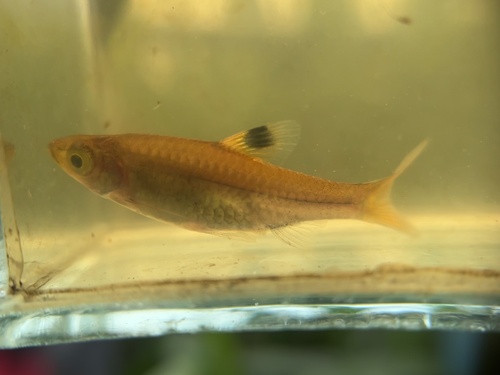
The Apollo sharkminnow (Luciosoma spilopleura) species of freshwater ray-finned fish belonging to the family Danionidae, the danios or danionins.
Care at a glance
Species-specific aquarium care
- Tank: At least 48 in long and 21 in front to back for one adult (adults commonly reach about 9.8 in / 25 cm).
- Water: Freshwater.
- Temperature: 75–81°F (range recorded for this species).
- Hardness: 5–8 dGH.
- Layout: Uses both the bottom and open water: give open swimming space plus cover near the substrate.
Calculated from this species' own FishBase record: tank size from its typical adult length and swimming zone, water values from its recorded ranges. The group guide below fills in general care.
Care guide
Species care notes
- Behaviour: a shoaling fish best kept in a group of six or more; suited to a community tank.
- Difficulty: Moderate (Seriously Fish rating).
From the Seriously Fish profile for this species, which has the full habitat, maintenance, diet, behaviour and breeding write-up 167
Danios and rasboras
Applies to most species in this group. Habitat: These Asian fishes occupy habitats ranging from zebra-danio pools and rice paddies to shaded harlequin streams, rocky Devario streams and planted galaxy-rasbora wetlands. [fg159-zebra, fg159-harlequin, fg159-giant, fg159-galaxy]. Individual species can differ, so compare with the species numbers above and the linked sources.
Housing & setup
- Use at least 90 × 30 cm (36 × 12 in) for zebra danios.
- Harlequins require at least 60 × 30 cm (24 × 12 in), shaded planted cover and subdued light.
- Devario aequipinnatus needs at least 120 × 45 cm (48 × 18 in), oxygenated water, moderate flow and a tight lid.
- Galaxy rasboras need dense planting and broken sight lines in at least 45 × 30 cm (18 × 12 in), with gentle sponge filtration.
- Match chemistry: harlequins pH 5.0–7.5, 1–12 dGH; galaxy rasboras pH 6.5–7.5, 5–15 dGH.
Climate & lighting
| Water | 64.4–77°F |
Diet
- Quality flakes or granules sized to the fish.
- Live or frozen Daphnia and Artemia.
- Bloodworms for zebra danios, harlequins and Devario.
- Small sinking foods for galaxy rasboras, which rarely feed at the surface.
Social life
- Keep zebra danios and harlequins in groups of at least 8–10. Galaxy males spar: dense cover and larger groups distribute aggression. Active Devario can overwhelm timid feeders.
Health watch
- Pseudoloma microsporidiosis in zebra danios.
- Pleistophora infection and columnaris can produce similar white lesions in zebra danios.
- Nipped fins among rival galaxy males.
Understanding the animal
About this animal
About this animal
This fish is found in Thailand, Sumatra and Borneo.
Quoted from the Wikipedia article “Apollo sharkminnow” (CC BY-SA 4.0) 174
In the wild
In the wild
From this species’ own FishBase record (habitat, bottom type, water and breeding data), not its family. Good care copies these conditions.1
| Where it lives | Lives in freshwater. Uses both the bottom and open water. Known from high gradient rivers with rocky, stony or gravel bottoms. |
| Water it lives in | Freshwater, 75–81 °F (24–27 °C), pH 6.5, hardness 5–8 dH. |
| Climate | Tropical climate. |
What this means for care
- Keep water within its wild range, 75–81 °F.
From the sources
From the sources
Quoted from the matching sections of reputable sources for this exact species. Specialist databases are used first; Wikipedia (community-edited, CC BY-SA 4.0) only fills gaps. Other sources are short credited quotes.
| Where it lives | Home ranges Population dynamics Growth parameters Max. ages / sizes Length-weight rel. Length-frequencies Mass conversion Recruitment Abundance Life cycle Reproduction Maturity Maturity/Gills rel. — FishBase |
| Biology | Known from high gradient rivers with rocky, stony or gravel bottoms. — FishBase |
Data and studies
The numbers
The numbers
Each bar is what one source reports. Where several sources weigh in, the dashed gold band marks their average.
Adult length
Maximum recorded length. Measured as total length. Fish in home aquariums often stay smaller than wild records.
Water temperature
Range the species tolerates in nature; aim for the middle.
Water hardness
Sources for this sheet
- FishBase (Froese & Pauly, eds.), version 24.07 Peer-reviewed researchThe global scientific database on fishes, maintained by a consortium of research institutions; every value is referenced.
- Seriously Fish species profiles Experienced keeper or breederLong-running aquarium reference written and peer-checked by experienced fishkeepers and ichthyologists; each profile covers habitat, tank size, water, diet, behaviour and breeding.
- Seriously Fish: Zebra danio (Danio / Brachydanio rerio) Experienced keeper or breederAdded in the 2026 source-checked care-guide review.
- Seriously Fish: Trigonostigma heteromorpha Experienced keeper or breederAdded in the 2026 source-checked care-guide review.
- Seriously Fish: Devario aequipinnatus Experienced keeper or breederAdded in the 2026 source-checked care-guide review.
- Seriously Fish: Danio / Celestichthys margaritatus Experienced keeper or breederAdded in the 2026 source-checked care-guide review.
- Wikipedia (species article) Community referenceFree encyclopedia; useful overviews with their own citations. Intro text is quoted under CC BY-SA 4.0.
More danios and rasboras

Barred danio
Devario pathirana
Aquarium hobby

Bengal danio
Devario devario
Aquarium hobby

Betadevario ramachandrani
Betadevario ramachandrani
Aquarium hobby

Blackline rasbora
Rasbora borapetensis
Aquarium hobby

Blue danio
Danio kerri
Aquarium hobby
Brevibora cheeya
Brevibora cheeya
Aquarium hobby