Care at a glance
Species-specific aquarium care
- Tank: At least 24 in long and 12 in front to back for one adult (adults commonly reach about 1.6 in / 4.13 cm).
- Water: Freshwater.
- Layout: Uses both the bottom and open water: give open swimming space plus cover near the substrate.
- Availability: Rarely or never seen in the aquarium trade; expect to source it from specialists or not at all.
Calculated from this species' own FishBase record: tank size from its typical adult length and swimming zone, water values from its recorded ranges. The group guide below fills in general care.
Care guide
Species care notes
- Tank: a base of at least 18 × 12 in (roughly 11 US gallons); space needed is rated “modest tank”.
- Water: soft, acidic water, 72–88 °F, pH 4–6.5, 1–3 dGH.
- Behaviour: in a pair; not a community fish.
- Difficulty: Moderate (Seriously Fish rating).
Short excerpts from the species profile:
- Setup: “Provided adequate cover and structure is available this species is unfussy with regards to décor with ceramic flowerpots, lengths of plastic piping and other artificial materials all useful additions.”
- Tankmates: “Best maintained alone or with small ' dither' fishes such as Nannostomus spp., and ideally should not be mixed with other Apistogramma.”
- Breeding: “Substrate spawner which normally lays its eggs in crevices or cavities among the décor.”
From the Seriously Fish profile for this species, which has the full habitat, maintenance, diet, behaviour and breeding write-up 167
South American dwarf cichlids
Applies to most species in this group. Habitat: Soft, acidic, leaf-littered streams. Individual species can differ, so compare with the species numbers above and the linked sources.
Housing & setup
- Use species-specific water chemistry and tank base dimensions: M. ramirezi has a source minimum base of 60 × 30 cm; M. altispinosus has 90 × 45 cm. Provide fine sand for these substrate-sifting species.
- Very sensitive to nitrate and water swings; mature, stable tanks are best.
Climate & lighting
Starting point only: Replace the merged genus range with separately sourced species water temperatures. Check the species-specific values for this animal where shown.
| Water | 76–84°F |
Diet
- Small live and frozen foods (bloodworms, brine shrimp, daphnia) plus quality micro pellets.
Social life
- Harems or pairs; peaceful with small dither fish.
Health watch
- Use mature, stable aquaria. Warm-water M. ramirezi has a source maintenance range of 27–30 °C (81–86 °F), whereas M. altispinosus has 24–28 °C (75–82 °F).
Understanding the animal
In the wild
In the wild
From this species’ own FishBase record (habitat, bottom type, water and breeding data), not its family. Good care copies these conditions.1
| Where it lives | Lives in freshwater. Uses both the bottom and open water. Occurs exclusively in a small forest brook. Collected together with Laetacara flavilabris, Crenuchusspilurus, Aequidens sp., three Cichlasoma sp., several medium to adult size specimens of two still undetermined species of Rivulus, and adult specimens of a species of Hyphessobrycon. A few females were observed carrying small fry. |
| Water it lives in | Freshwater. |
| Climate | Tropical climate. |
| Behavior to plan for | Breeding: nesters, maternal parental care. |
What this means for care
- Parents guard eggs or young, so expect territorial behavior when breeding.
From the sources
From the sources
Quoted from the matching sections of reputable sources for this exact species. Specialist databases are used first; Wikipedia (community-edited, CC BY-SA 4.0) only fills gaps. Other sources are short credited quotes.
| Where it lives | Home ranges Population dynamics Growth parameters Max. ages / sizes Length-weight rel. Length-frequencies Mass conversion Recruitment Abundance Life cycle Reproduction Maturity Maturity/Gills rel. — FishBase |
| Biology | Occurs exclusively in a small forest brook. Collected together with Laetacara flavilabris, Crenuchusspilurus, Aequidens sp., three Cichlasoma sp., several medium to adult size specimens of two still undetermined species of Rivulus, and adult specimens of a species of Hyphessobrycon. A few females were observed carrying small fry. — FishBase |
Data and studies
The numbers
The numbers
Each bar is what one source reports. Where several sources weigh in, the dashed gold band marks their average.
Adult length
Maximum recorded length. Measured as standard length (snout to the base of the tail, not counting the tail fin). Fish in home aquariums often stay smaller than wild records.
Water temperature
Range the species tolerates; aim for the middle.
pH
Water hardness
Minimum tank footprint
Seriously Fish recommends a tank base of at least 18 × 12 in (about 11 US gallons).
Sources for this sheet
- FishBase (Froese & Pauly, eds.), version 24.07 Peer-reviewed researchThe global scientific database on fishes, maintained by a consortium of research institutions; every value is referenced.
- Seriously Fish species profiles Experienced keeper or breederLong-running aquarium reference written and peer-checked by experienced fishkeepers and ichthyologists; each profile covers habitat, tank size, water, diet, behaviour and breeding.
- Merck Veterinary Manual: Management of aquarium fish Zoo, university or veterinaryThe Merck Veterinary Manual: a standard veterinary reference written and reviewed by veterinary specialists.
- Merck Veterinary Manual: Types and features of aquatic systems Zoo, university or veterinaryThe Merck Veterinary Manual: a standard veterinary reference written and reviewed by veterinary specialists.
- Seriously Fish — Mikrogeophagus ramirezi Zoo, university or veterinaryAdded in the 2026 source-checked care-guide review.
- Seriously Fish — Mikrogeophagus altispinosus Zoo, university or veterinaryAdded in the 2026 source-checked care-guide review.
More cichlids

Agassiz's dwarf cichlid
Apistogramma agassizii
Aquarium hobby

Altolamprologus calvus
Altolamprologus calvus
Aquarium hobby

Altum Angel
Pterophyllum altum
Aquarium hobby
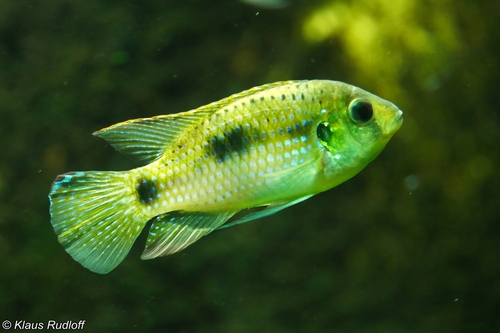
Anomalochromis thomasi
Anomalochromis thomasi
Aquarium hobby

Apistogramma eremnopyge
Apistogramma eremnopyge
Aquarium hobby
Argentine humphead
Gymnogeophagus balzanii
Aquarium hobby