Home / Reptiles / Alligators and caimans / American alligator
Some federal rules apply In-depth sheetAmerican alligator
Alligator mississippiensis
Reptiles › Alligators and caimans (Crocodylia) › Alligatoridae (Alligators and caimans)
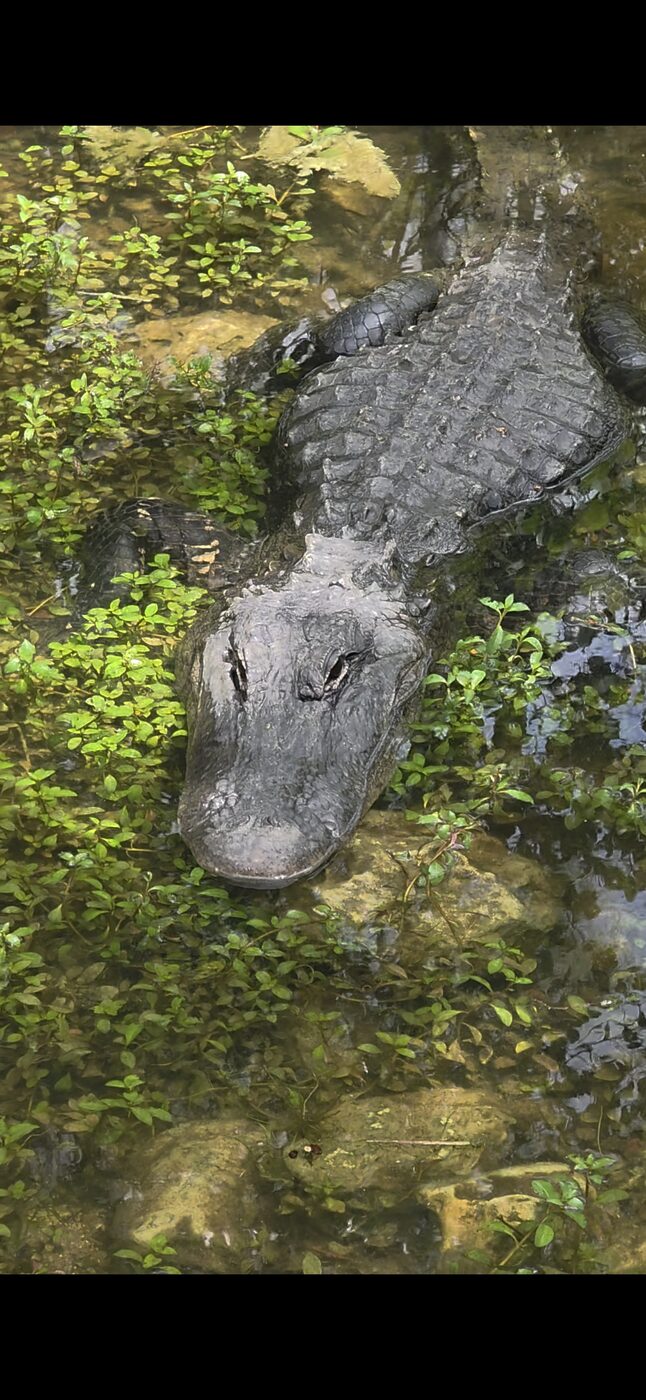
American alligators grow large (females about 8.5–10 ft, males usually 11–12 ft and exceptionally near 15 ft) and can live about 50 years in captivity. Cute hatchlings become dangerous adults; Clint's Reptiles scores them 2.6/5.
Warnings
Care guide
Growth
- Males grow fast until about 20 years old, reaching about 11.5 ft; females average about 8.4 ft.
Sources 78
Care
- Large, well-filtered water and a warm basking spot are the basics; size makes handling dangerous.
Sources 112
Show the group care guide for crocodilians
Crocodilians
Applies to most species in this group. Habitat: Tropical and subtropical wetlands. Individual species can differ, so compare with the species numbers above and the linked sources.
Housing & setup
- Very large, heated indoor-outdoor facilities with deep pools, haul-out areas and double-secure fencing.
- Water quality and temperature control are critical.
Climate & lighting
| Basking spot | 90–95°F |
| Water | 78–84°F |
- UVB: Recommended.
Diet
- Whole prey: fish, rodents and poultry, with vitamin and mineral supplementation.
Health watch
- Bites and tail strikes cause serious injury.
- Dwarf caimans stay smaller (4–5 ft) but are still powerful and long-lived.
Understanding the animal
In the wild
In the wild
Researched for this exact species, not its family. Good care copies these conditions.123
| Where it lives | Swamps, marshes, ponds, lakes and rivers of the southeastern United States. Smaller animals use sheltered wetland margins; adults also use open water and banks. |
| Ground it lives on | Muddy banks and wetland soil; excavated holes and terrestrial nesting sites. |
| Water it lives in | Mainly freshwater, still or slow-flowing rivers, swamps, marshes and lakes; brackish or saline exposure is temporary because it lacks salt glands. Wild chemistry and temperature ranges were not established. |
| Climate | Southeastern temperate to subtropical conditions with seasonal winter cooling and occasional drought; uses excavated refuges in extreme weather. Measured temperature and humidity ranges were not established. |
| Active | Cathemeral: daytime basking and nighttime breeding activity are documented; cold weather produces seasonal dormancy (brumation). |
| Social life | Territorial adults can aggregate; hatchlings remain together under maternal protection. |
| Wild diet | Young eat small fish, insects and other invertebrates; larger animals take fish, mammals, reptiles and birds. |
| Behavior to plan for | Swims, excavates refuge holes and walks on land. Its size, predatory behavior and powerful jaws require protected management. |
What this means for care
- Provide both substantial freshwater swimming space and accessible land.
- Include sheltered margins for small animals and refuges from exposure.
- Plan separation around territoriality and large size differences.
Native climate (measured)
Native climate (measured)
| Warm-season highs | about 91°F (up to 92°F in the hottest sampled areas) |
| Cool-season lows | about 50°F (down to 42°F in the coldest sampled areas) |
| Average temperature | 68–75°F across sampled records |
| Relative humidity | 72–74% on average (driest month about 69%) |
| Rainfall | about 1289 mm a year |
Measured at 134 wild occurrence records sampled against WorldClim 2.1 climate data (1970–2000 averages). Air conditions in the range are ecological context, not enclosure settings: microhabitats such as burrows, leaf litter or basking rocks can be cooler, warmer or more humid.
Profile
Profile
Researched for this exact species. Sources are listed under In the wild above.
History
The American alligator is native to North America and the southeastern United States. The supplied Animal Diversity Web source also notes short-lived occurrences outside its native range after formerly captive animals were released.
Keeper tips
- Provide both aquatic and terrestrial areas rather than treating the species as completely aquatic.
- Base the aquatic environment primarily around freshwater rather than saltwater.
- Include sheltered or vegetated areas in addition to open water.
- Account for the enormous adult size described for the species when planning space.
- Expect bellowing and territorial communication, particularly around the breeding season.
Behaviors reported
- Creates alligator holes by excavating mud or soil with the snout and tail.
- Bellowing is used to advertise territory and find mates.
- Males use infrasound to attract females.
- Mothers guard nests and may carry hatchlings to water in their mouths.
- Parental care can continue well beyond hatching.
Unique adaptations
- It tolerates cooler climates better than the American crocodile.
- Its broad U-shaped snout distinguishes it from the sympatric American crocodile.
- Young have yellow body bands.
- Excavation of gator holes provides refuge from drought and irregular weather.
Remarkable facts
- Adult males commonly reach about 11 to 12 ft, with exceptional males near 15.7 ft, and may weigh up to about 1,000 lb.
- Females are smaller, at about 8.5 to 11 ft.
- It is the crocodilian with the northernmost natural distribution according to the supplied Animal Diversity Web source.
- It functions as an apex predator.
- Its alligator holes act as wet and dry habitat for other organisms, making the species an ecosystem engineer.
- Its natural distribution extends from areas of North Carolina south through Florida and west to central Texas, with additional populations in several southeastern states.
From the sources
From the sources
Quoted from the matching sections of reputable sources for this exact species. Specialist databases are used first; Wikipedia (community-edited, CC BY-SA 4.0) only fills gaps. Other sources are short credited quotes.
| Overview | The American alligator (Alligator mississippiensis), sometimes referred to as a common alligator or just gator, is a large crocodilian reptile native to the Southeastern United States. It is one of the two extant species in the genus Alligator, and is larger than the only other living alligator species, the Chinese alligator. Adult male American alligators measure 3.4 to 4.8 m in length, and can weigh up to 450 kg, with unverified sizes of up to 5.84 m and weights of 1000 kg making it the heaviest member of the family Alligatoridae, and the second longest one, after the black caiman. — Wikipedia (community-edited) |
| Where it lives | Although sometimes found in brackish water settings, the American alligator is most commonly found in freshwater environments of the temperate region due to its low tolerance for salt. — Animal Diversity Web |
| Reproduction | Oviparous; temperature-dependent sex determination (TSD, see Valenzuela & Lance 2004 for details). — The Reptile Database |
| Appearance and size | As a hatchling, an alligator is typically 22.9 cm long. — Animal Diversity Web |
| History and naming | Named after the type locality. — The Reptile Database |
Data and studies
The numbers
The numbers
Each bar is what one source reports. Where several sources weigh in, the dashed gold band marks their average.
Lifespan in care
Maximum recorded lifespan
Longest recorded lifespan reported by each database; typical lifespans are usually shorter. The AnAge record comes from an animal in human care.
Typical adult weight
Average adult body mass in each database (FishBase gives the maximum recorded weight).
Incubation
Veterinary & husbandry research
Veterinary & husbandry research
- Steatitis and fat necrosis in captive alligators Larsen RE et al., Journal of the American Veterinary Medical Association 1983
- Pathology of experimental mycoplasmosis in American alligators Brown DR et al., Journal of wildlife diseases 2001
- Detection of West Nile virus RNA in mosquitoes and identification of mosquito blood meals collected at alligator farms in Louisiana Unlu I et al., Journal of medical entomology 2010
- Parental exposure to pesticides and poor clutch viability in American alligators Rauschenberger RH et al., Environmental science & technology 2007
Peer-reviewed papers that mention this species alongside captivity, zoos, veterinary care or aquaculture. Some cover several species or mention it only in passing, so check the abstract. See all 45 on PubMed → 170
Sources for this sheet
- Animal Diversity Web (University of Michigan): Alligator mississippiensis Zoo, university or veterinaryUniversity-hosted species account, mostly wild biology.
- Clint's Reptiles (YouTube): American Alligator, The Best Pet Crocodilian? Expert educator & keeperClint Laidlaw, PhD in Biology Education and MS in Evolutionary Ecology; owner of Clint's Reptile Room and a longtime keeper. Rates each species on handleability, care, hardiness, availability and upfront cost.
- AnAge: The Animal Ageing and Longevity Database (Human Ageing Genomic Resources) Peer-reviewed researchCurated, referenced longevity and life-history records for thousands of species; maximum lifespans are often from zoo animals.
- Myhrvold et al. (2015). An amniote life-history database. Ecology 96: 3109 Peer-reviewed researchPeer-reviewed compilation of life-history data for over 21,000 birds, mammals and reptiles.
- 50 CFR 17.11: Endangered and threatened wildlife Zoo, university or veterinaryCurrent federal Endangered Species Act list.
- Species+ (UNEP-WCMC and the CITES Secretariat) Zoo, university or veterinaryThe official database of species listed under CITES.
- USFWS International Affairs: CITES Zoo, university or veterinaryFederal agency that issues CITES permits.
- Merck Veterinary Manual: Management and husbandry of reptiles Zoo, university or veterinaryThe Merck Veterinary Manual: a standard veterinary reference written and reviewed by veterinary specialists.
- Merck Veterinary Manual: Nutritional, metabolic and endocrine diseases of reptiles Zoo, university or veterinaryThe Merck Veterinary Manual: a standard veterinary reference written and reviewed by veterinary specialists.
- Merck Veterinary Manual: Management of zoo animals Zoo, university or veterinaryThe Merck Veterinary Manual: a standard veterinary reference written and reviewed by veterinary specialists.
- Clint's Reptiles (YouTube): American Alligator, The Best Pet Crocodilian? Expert educator & keeperClint Laidlaw, PhD in Biology Education and MS in Evolutionary Ecology; owner of Clint's Reptile Room and a longtime keeper. His "Best Pet?" series reviews each species' care in depth.
- The Reptile Database Peer-reviewed researchScientist-curated catalog of every reptile species, with taxonomy and literature.
- GBIF Backbone Taxonomy (Global Biodiversity Information Facility) Peer-reviewed researchInternational scientific taxonomy used here for classification.
- Wikipedia (species article) Community referenceFree encyclopedia; useful overviews with their own citations. Intro text is quoted under CC BY-SA 4.0.
- PubMed (U.S. National Library of Medicine) Peer-reviewed researchIndex of peer-reviewed veterinary, zoo and husbandry research.
- iNaturalist (captive observations) Community referenceCommunity observation platform run by the California Academy of Sciences and National Geographic; observations marked captive show animals living in homes, zoos and aquariums.